AI assistants do not send browsers. They send buyers. When WebFX studied 590,868 visits from AI tools to 2,500 web pages, about 92 percent of them landed at the consideration or decision stage, and nearly 69 percent had transactional intent. Only 2.3 percent were people just starting to learn. By the time ChatGPT or Google's AI sends someone to your site, it has usually already told them you are one of the two or three companies worth calling.
That changes what content is for. We are a video production and marketing studio in Grand Blanc, Michigan, and most of what the research says wins in AI search is what we already make every week: video people can quote, pages that answer a buyer's real question, and proof from real jobs. This is our field guide to it, with the numbers, and with what we have built for our clients and our own site so you can see the ideas in the wild.
At a glance
- AI traffic is late-stage traffic. Visitors arrive ready to compare and buy, so your decision pages matter most.
- Video is the most cited source in Google's AI. YouTube leads citations in AI Overviews, and brand mentions in videos track closely with AI visibility.
- Specific beats clever. Prices, process, named examples and first-hand proof earn citations. Generic tips do not.
- Skip the gimmicks. Google says no special AI files are needed, and schema alone did not raise citations in a controlled test.
- Measure leads, not mentions. Studies disagree on how AI traffic converts. Track it separately and judge it on enquiries.
The short answer
The content that earns AI traffic is the content a careful buyer wants right before they choose: a homepage that says clearly who you serve and why to trust you, service pages with real prices and a real process, answers to specific questions, video that shows the work, and proof that you have done it before. In WebFX's scoring, the pages earning AI visits averaged 4.76 out of 5 for specificity, more than half contained original research or first-party data, and pages that cited their sources drew 26 percent more AI traffic than pages that did not.
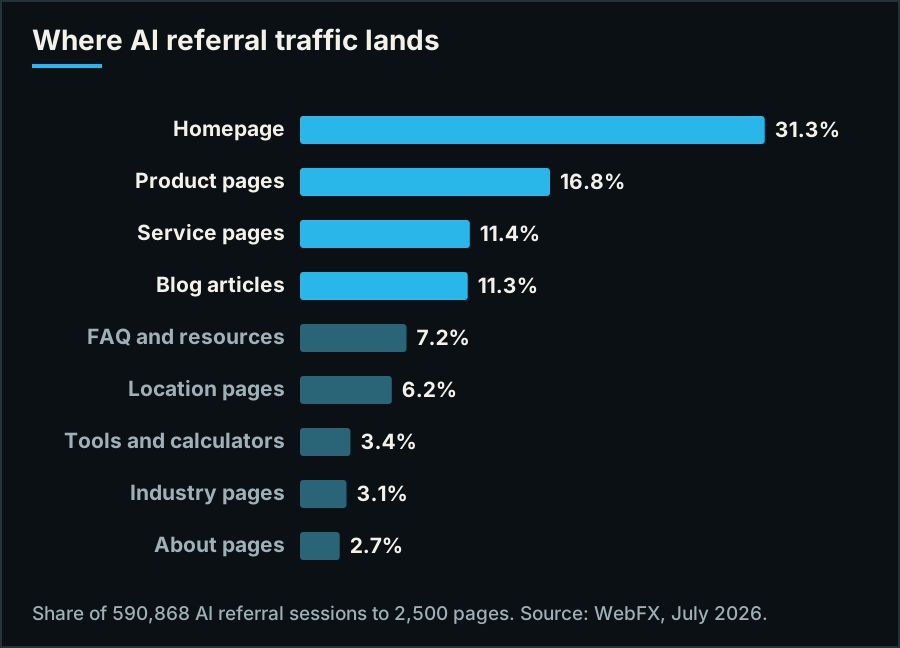
Where AI referral sessions land, by page type. The homepage and the pages that sell do most of the work.
1. A homepage that answers "why you"
The homepage took 31 percent of all AI sessions in the WebFX data, more than any other page. When an assistant recommends a company, people check the homepage first, and it has seconds to confirm what the AI said: who you serve, what makes you different, and why you can be trusted.
On our own homepage, the trust is specific and checkable. The recognition section names the festival laurels our comedy series has earned, with the real counts: five wins and 33 laurels from 24 festivals across five episodes, made in collaboration with Hot Cheap Comedy, who write the scripts while we handle production, directing, cinematography, editing and post. It names our contribution to the first season of VICE TV's Dark Side of the Ring, the Ring of Honor pay per view story we built from raw footage, and our nominations with the Flint and Genesee Chamber. Every one of those is a fact an AI tool can match to another source. "Award-winning agency" with nothing behind it is not.
2. Service pages with prices and a process
AI visitors are shopping, so the pages that convert them are the ones that answer shopping questions: what does it cost, how long does it take, what happens first, and what do I get. WebFX's playbook calls this commercial depth. Most small business service pages have none of it.
This is why we put tools on our service pages instead of "contact us for pricing". Our video cost estimator gives an indicative range for a shoot in seconds. The website cost calculator prices a site by type, pages, platform and features and shows the 2026 market ranges beside it. The CRM cost calculator uses CRM Connect's published plan prices. And our web design page shows the whole redesign process as a timeline, week by week, with what we need from you in each phase. That is exactly the kind of specific, structured answer an assistant can summarize and send someone to.
For clients, the same idea shows up in their sites. For Cranbrook apartments we gave every floor plan its own page with the drawing, photos, the size and a way to ask about it, which means a question as specific as "two bedroom floor plans near me" has a specific page to land on. Here is how we build those sites.
3. Video that shows the work, with words AI can read
This is the part most small businesses are missing, and the part we know best. BrightEdge found YouTube is the single most cited domain in Google's AI Overviews, at about 29.5 percent of citations, and the top source in AI Mode too. The video types cited most are tutorials, demonstrations, reviews, comparisons and current pricing. Separately, Ahrefs studied 75,000 brands and found that mentions of a brand in YouTube titles, descriptions and transcripts correlated more strongly with AI visibility than anything else it measured, at about 0.74, far ahead of backlinks.
The detail that matters: the AI reads the words around the video. A video with no title, no description and no transcript is nearly invisible to it. So every video on this site has its own watch page with a written description, structured VideoObject data, its own share image and a link to the story behind it. Our featured clips carry proofread captions. And each episode of the comedy series has a behind-the-scenes article linked from the video and back, so the film and the words about it reinforce each other.
Event video is the clearest example of video working as proof. At the Attorneys Resource Conference, which we produce end to end in Grand Rapids, two films built from interviews we shot between sessions went out during the conference itself, and the organizers then used the same films to sell the following year. That event reel is now a page with a description, a date and the names of what is in it: a searchable record of the event, not just a file.
4. First-hand proof and your own numbers
Google's guidance for AI search is blunt about generic content: it warns against commodity pages and mass-produced variations, and favours first-hand experience. More than two thirds of the pages earning AI traffic in the WebFX study showed expert credentials, and over half contained original research or first-party data. The research paper that named the field, GEO from Princeton, found that adding statistics, quotations and cited sources raised visibility in AI answers by roughly 30 to 40 percent in its tests.
Your best original data is usually sitting in your own history. Pink Night Flint is ours: we were part of the founding team and did its first branding while working for Financial Plus Credit Union, and over our tenure the event went from giving about $5,000 a year to clearing $250,000 or more annually. That is a specific, attributable result, written up with what we actually did. It is worth more to a reader and to an AI than any list of "event marketing tips", because nobody else can write it.
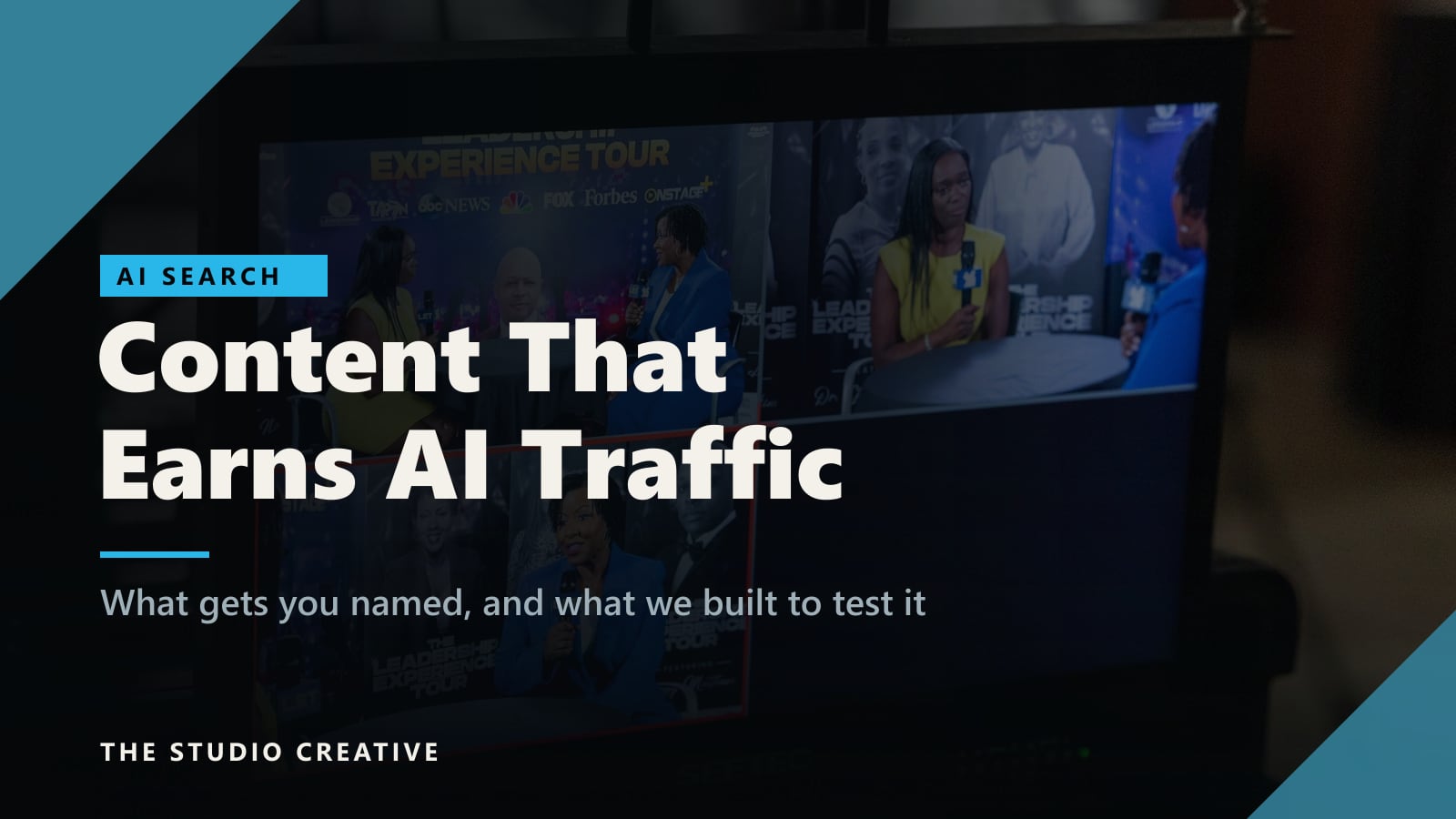
The same goes for guides built from real work. Our pro wrestling production guide comes from filming shows for promotions like LuchaBoom, with camera positions and an interactive ring you can walk around. Our conference planning guide comes from producing ARC and partnering on the Leadership Experience Tour, whose website, commercial and live broadcasts we built. Named author, named projects, specific craft. That is what the guidance means by experience.
5. Answers to the exact questions buyers ask
FAQ and resource pages took about 7 percent of AI sessions in the WebFX data, and they over-perform: their share of AI traffic ran more than five points above their share of Google traffic. Semrush published 81 FAQ-style test pages and saw Google's AI Mode cite 36 percent of them within a day.
Two rules make an answer quotable. Put it first: an analysis of 1.2 million ChatGPT answers found 44 percent of citations came from the first 30 percent of a page. And write it as visible text. Every article on this site opens with an "At a glance" box like the one above, and every FAQ is a plain question and answer, which also produces FAQ structured data automatically. But the markup is the bonus, not the point: a 2026 Ahrefs study of 1,885 pages found adding schema did not by itself raise AI citations. The answer on the page does the work.
What does not move the needle
- An llms.txt file as a strategy. Google says its AI features need no special AI text files or markup. Add one if you like; do not pay anyone to sell it to you as the reason you will be cited.
- Generic "top tips" posts. Google specifically warns against commodity content. If a hundred other sites could have written it, it will not be the one quoted.
- Chasing backlinks alone. In the Ahrefs brand study, links correlated weakly with AI visibility, while mentions of your brand across the web correlated strongly. Partners, press, podcasts and associations talking about you count for more.
- A slow, bloated site. Crawlers and people both give up on it. We cut our own homepage from 26MB to about 1MB on a phone this year and took its desktop PageSpeed score from 94 to the high 90s, and we hold every client build to the same standard.
Is AI traffic worth chasing?
Honestly, the studies disagree on how well it converts. WebFX reports AI visitors converting about 1.2 times better than organic search; Semrush put the value at 4.4 times; one software company, Ahrefs, saw AI bring 0.5 percent of its visits and 12.1 percent of its signups. But a study of 973 online stores found ChatGPT referrals converting worse than organic search. Our read: for considered purchases like a brand film, a website, an event crew or a marketing system, where people compare before they call, the visitor an AI sends is often well informed. The bigger cost is not the traffic you miss. It is the answer that names your competitor instead of you.
Two more things worth knowing. The volume is concentrated: ChatGPT sent about 97.5 percent of the AI referrals in the WebFX data. And freshness matters: Ahrefs found pages cited by AI assistants were about 25.7 percent fresher than those in ordinary search results, so keep key pages updated and show the date.
A 30 day plan for a small business
- Week 1: ask the machines. Put the five questions your customers ask most into ChatGPT, Gemini, Perplexity and Google, and write down who gets named and which pages are cited.
- Week 1: fix your identity. Make your business name, services, area and contact details match on your site, your Google Business Profile and your main directories.
- Week 2: rewrite your top three service pages answer first. Open with what it is, who it is for, a price range and how long it takes. Add a short process and five real FAQs.
- Week 3: dress your videos. Titles, descriptions, chapters and corrected transcripts on YouTube, and each video embedded on the page it supports.
- Week 4: publish one piece only you can write. A project story with real numbers, a cost guide from your own quotes, or a how-to from a job you finished last month. Name the author.
- Every month: measure. Separate AI referrals in your analytics, re-ask the same questions, and judge the work on enquiries.
FAQs
What is GEO?
Generative engine optimization is the work of getting your business mentioned and cited in AI-generated answers from tools like ChatGPT, Gemini, Perplexity and Google's AI Overviews. It builds on SEO and adds answer-first writing, video and transcripts, consistent listings and measuring the AI answers themselves.
What type of content gets cited by AI the most?
By share of AI visits, homepages, product pages, service pages and blog articles lead. By citation source in Google's AI features, YouTube leads. Across all of them, specific content with prices, process, named examples and first-hand proof outperforms generic advice.
Do I need special markup or an llms.txt file for AI search?
No. Google says its AI features need no special files or markup. Structured data still helps rich results and makes your details unambiguous, but a controlled study found it did not raise AI citations on its own.
Does video help with AI search?
Yes, especially in Google's AI Overviews and AI Mode, where YouTube is the most cited domain. The words around the video matter: titles, descriptions, chapters and transcripts that name your business.
Where we come in
AI search rewards the things a production studio makes anyway: video with a story, pages that answer real questions, and proof from real work. If you want to know what ChatGPT and Google's AI say about your business today, we will check it for free and tell you what to fix first. See our GEO and AI search optimization service, or start with the SEO the rest is built on.