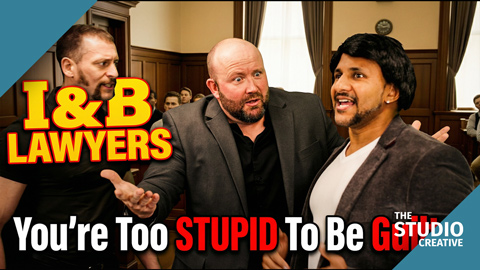
I&B Lawyers is a parody of a very specific genre: the late-night personal injury commercial. You know the one. The wood-paneled office, the confident point at the camera, the phone number that rhymes. The Hot Cheap Comedy version was pitched on a Monday, read on a Tuesday, shot on a Thursday, and published the following week. This post is about the writing room as much as the shoot, because on this series the writing is where the speed comes from.
At a glance
- A week, pitch to publish. Pitched on a Monday, read on a Tuesday, shot on a Thursday, published the following week.
- A recorded writers' room. Every table read is recorded and transcribed, and the writers punch up from the transcript.
- Sets that do not exist. The wood-paneled office and the courtroom both started as Studio Projects backgrounds.
- Shot like the real thing. A slightly long, slightly low lens for the point at the camera, and a practical handshake.
Watch I&B Lawyers on its own page.
On the festival circuit
I&B Lawyers has been a semi-finalist at four festivals: the Indiana Independent Film Festival, the Brooklyn International Short Awards, the Arthouse Festival of Beverly Hills, and the Hollywood International Golden Age Festival. It was also an official selection at BIMFF, the Brazil Independent Magazine and Independent Film Festival. No win yet for this one. Its series mates Morning Groove and WiFi Help Desk carry the trophies, five festival wins between them.
The writing room
Hot Cheap Comedy's owner, Josh Gulban, trained in sketch writing at Second City Chicago, and the room runs on that structure: premise, escalation, turn, out. What the room adds is a cast of current and former pro wrestlers who have spent years writing character in real time in front of crowds. The table read is loud. Lines get pitched over each other. The good ones survive.
The problem with a room like that is that the best line is often said once, by someone who does not remember saying it. So every table read is recorded and transcribed, and the writers punch up from the transcript the next morning.
Studio Projects: from a script upload to a courtroom in a day
The speed on this episode comes from one step. The shooting script from the table read is uploaded to Studio Projects, the software we built for exactly this, and it comes back broken down scene by scene with a visual example of each scene, a description of every character, and a shot list per character so we can see at a glance who is in how many scenes. It also generates the background images for the green screen: the wood-paneled office and the courtroom for the "your day in court" beat both started as Studio Projects backgrounds, lit and enhanced from there.
Filming: the office and the courtroom that do not exist
The set is the joke, so the set had to be right. Wood paneling, a bookshelf of matching spines, a flag, a desk that is slightly too large, and for the "your day in court" beat, a full courtroom with a bench, a seal, and a gavel. None of it was built. Both environments came out of Studio Projects as generated backgrounds, chosen at the table read so the gaffer could light the performers to their lighting notes before anyone arrived.
Drag the handle to see what the camera saw against what the audience saw:
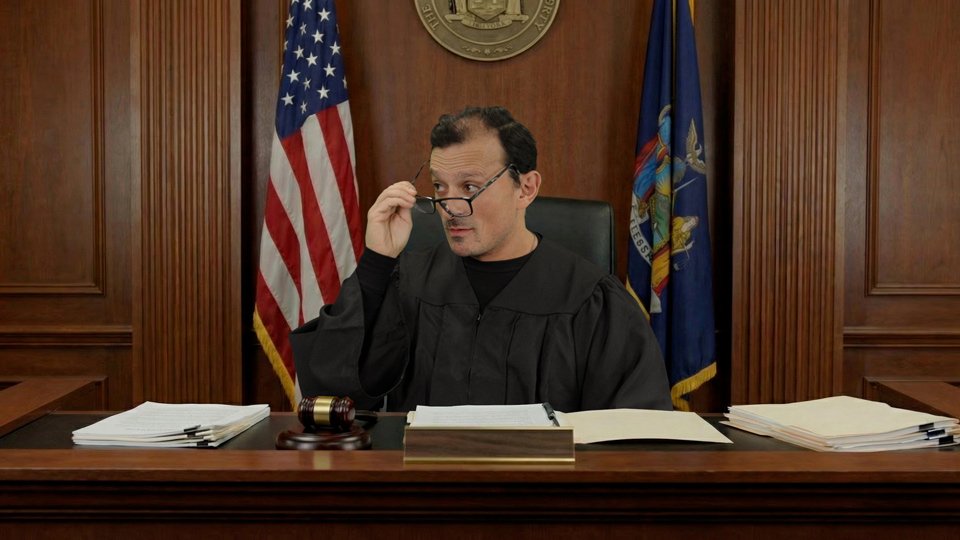
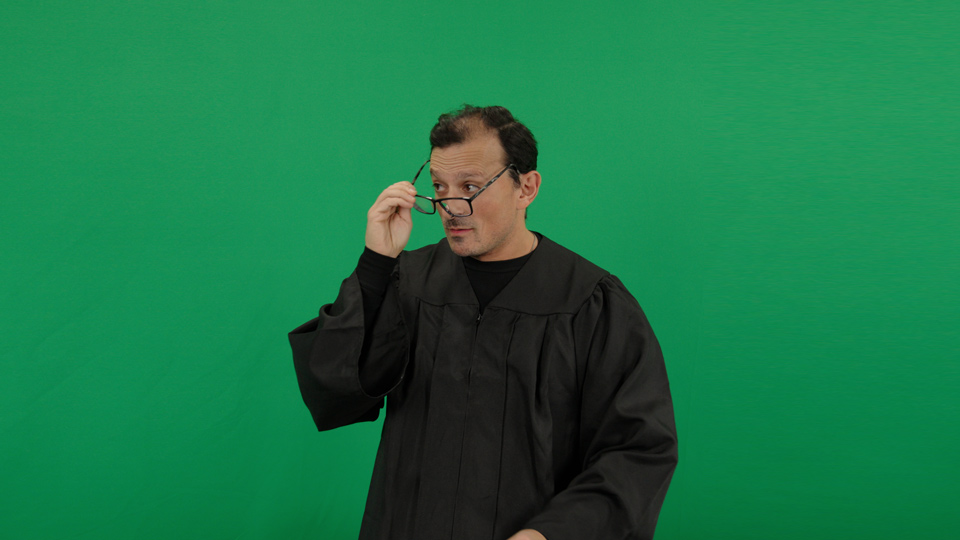 Before: green screenAfter: virtual courtroom
Left of the line is the green screen stage in Grand Blanc. Right of the line is the courtroom generated in Studio Projects, keyed and lit to match. The robe, the glasses, and the papers on the desk are the only things that were real.
- The point at the camera: the whole genre lives on that gesture, so we shot it on a slightly long lens, slightly low, the way the real commercials do. The virtual set was rendered from a matching camera so the perspective on the desk agrees with the lens on the actor.
- The handshake: two performers, one practical handshake, in front of green. Practical contact between actors is always shot for real. The moment two composited people touch is the moment a composite fails.
- Wardrobe: checked on the rough-key monitor before rolling. A navy suit is fine. A teal tie is a problem, and it was caught on the monitor, not in the edit.
Editing: making it look like the real thing
A parody of a low-budget commercial has to look like a low-budget commercial, and that is harder than it sounds when your footage is clean. The finish added a slight softness, a broadcast-safe crush to the blacks, and a lower-third graphic in the exact typographic taste of the genre. The music is a stock-sounding cue we produced in-house so there is no licensing problem when the episode travels.
AI, and the line we hold on writing
AI transcribes our table reads, organizes the punch-up, cleans up audio, and pulls the rough mattes. It does not write the jokes. We have tried it, in the spirit of finding out, and the output is a competent imitation of a sketch that has already been made. The room is faster and funnier than that, and the audience can tell.
What this means for your brand
A week from pitch to publish is not a comedy trick. It is a pipeline: a writing process that captures everything, a set library that is lit before the shoot, and an edit that starts from an organized assembly. We run the same pipeline for law firms and legal nurse consultants who need real content every week rather than one big video a year.
Want this pipeline for your brand?
Everything in this post, from the green screen stage and the generated backgrounds to the AI-assisted edit and Studio Projects itself, is the same pipeline we use for brand films and commercials out of Grand Blanc, Michigan. If you want more video without a bigger budget, tell us what you're making and you'll get a real producer's reply, not a rate sheet. Browse the rest of the series on our work page.