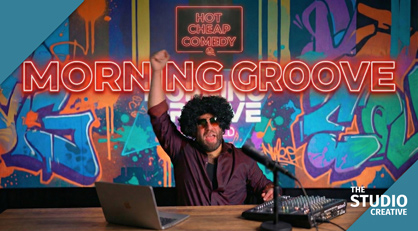
Most of what makes Morning Groove feel like morning radio never appears on screen. The stingers, the traffic-and-weather bed, the too-loud jingle, the compressed "you're on the air" voice: that is the set. The virtual booth is almost a formality. This post is about producing a sketch where sound design carries the world, and about the line we hold on AI-generated music.
At a glance
- Three festival wins. Comedy Short at the Bangkok Movie Awards, Super Short Films at AltFF and 1 to 5 Minutes at the Couch Film Festival. Hot Cheap Comedy wrote the script; we did everything else.
- The sound is the set. Stingers, a traffic bed, an in-house jingle and broadcast-style voice processing build the world.
- Real glass, virtual booth. A sheet of acrylic in front of the green gives the composite real reflections.
- Performing to real cues. The bed, the stingers and the producer cues played live into the performers' headphones.
Watch Morning Groove on its own page.
Award-winning: three festival wins for Morning Groove
Morning Groove is the most decorated episode of Hot Cheap Comedy so far. It has won at three festivals and collected seventeen laurels in all, from festivals in Thailand, Canada, the United States, Sweden, Hong Kong, and Brazil. For a sketch that runs under five minutes and was shot in one room in Grand Blanc, Michigan, that is a long way to travel.
- Comedy Short winner, Bangkok Movie Awards. The Bangkok Movie Awards is an international competition based in Bangkok, Thailand. It judges in monthly rounds, and the monthly winners go forward to the festival's annual gala. Morning Groove took the Comedy Short category.
- Super Short Films winner, AltFF Alternative Film Festival. AltFF is an IMDb-qualifying festival in Toronto that runs four editions a year. Its Super Short category is for films of one to five minutes, a length with no room for a slow start: the world has to exist by the second line.
- 1 to 5 Minutes winner, Couch Film Festival. Also Toronto, also quarterly, and IMDb-eligible, with each edition's finalists screened at a live event in the city. The 1 to 5 Minutes category is open to films of any genre.
Beyond the three wins, Morning Groove was a finalist at the Humro Cinema Film Fest and the Indiana Independent Film Festival, a semi-finalist at the Hollywood International Golden Age Festival, the Hong Kong Indie Film Festival, the Nashville Independent Filmmakers Festival, the Ottawa Film Award, and the Sweden Film Awards, and a quarter-finalist at the Lit Laughs International Comedy Film Festival. The complete record is listed at the end of this post.
Our read on why it won
We were not in any jury room, so take this as a producer's guess. Festival juries screen hundreds of shorts, mostly on laptops, often on headphones. A sketch whose entire world is built out of sound arrives intact in exactly that setting. There is no expensive location for a small screen to flatten. There is a jingle that is a little too loud, a voice that is a little too compressed, and two performers reacting to cues they could really hear. Everything the rest of this post describes, the acrylic "glass," the live cue session, the broadcast processing on the voices, is the craft those juries were responding to.
It is also why we can describe The Studio Creative as an award-winning video production company in Michigan without an asterisk. The wins are named, the festivals are real, and the episode is right above this paragraph.
The virtual booth
The radio booth came from our Studio Projects, but it needed one thing our library did not have: the glass. A radio booth is defined by a window with a producer behind it, and glass is the hardest surface to fake in a composite because it reflects the room you are not in. We solved it practically. A real sheet of acrylic on a stand, in front of green, with a small light aimed at it so the reflections in the final composite are real reflections of the real performers. The virtual room sits behind the acrylic; the highlights on it are from our stage. It is the kind of detail nobody notices, which is the point.
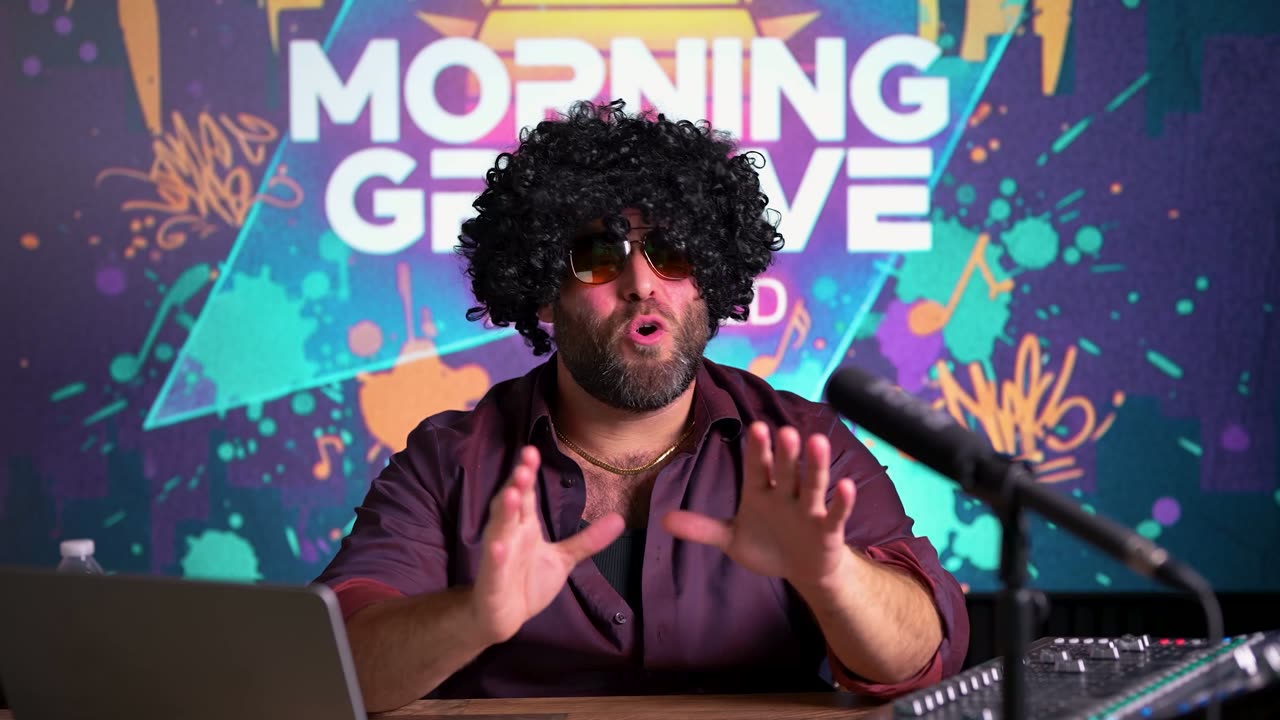
The host at the mic.
Filming: performing to sound
Radio hosts react to what they hear in the cans. So the performers wore real headphones with the actual bed, stingers, and producer cues played into them live. The timing of every reaction in the episode is a reaction to a real cue. We built the audio session before the shoot and played it from a laptop with a talkback mic for the "producer." It cost an afternoon of prep and saved us from fixing every reaction in the edit.
- Mics: real broadcast mics on real arms, wired to nothing, because the props carry the location. The lavs did the actual recording.
- Lighting: the Studio Projects note for the booth calls for a soft, slightly cool overhead with warm practical accents. We used two small practical lamps in frame and matched the virtual ones to them.
- Coverage: a wide through the acrylic and two singles. The wide is the money shot because the reflections sell the glass.
Editing and audio post: the sound is the set
The mix was built like a radio broadcast, not like a video. The hosts' voices run through a chain that imitates broadcast processing: heavy compression, a little presence bump, and the slightly-too-bright top end of an FM signal. When the sketch cuts to "reality," that processing drops off and the voices sound like people in a room. The audience feels the switch without being told about it.
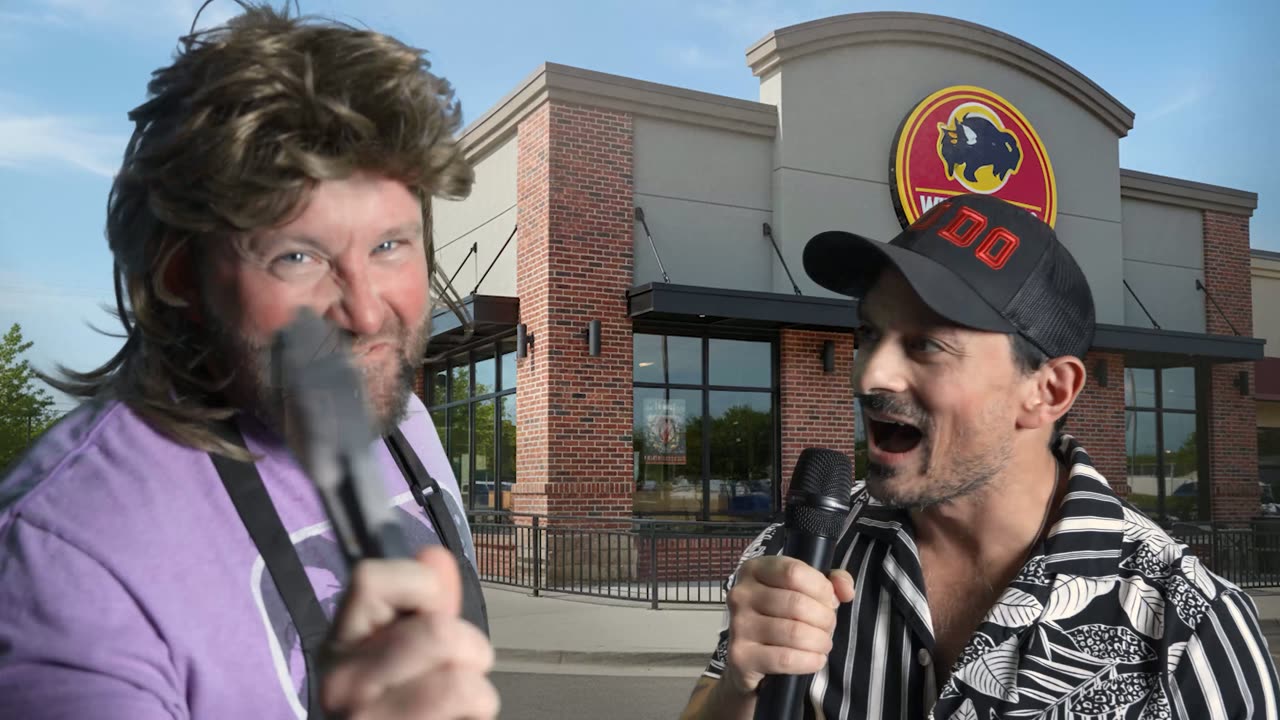
A street interview outside a restaurant.
The jingle, the traffic bed, and the stingers were produced in-house. We wrote and recorded them, because a parody jingle that sounds like a real jingle is a specific craft and because owning the music means the episode can go anywhere without a licensing problem.
AI in the audio pipeline
We use AI audio tools every day. On Morning Groove they did the cleanup and the tedium: dialogue isolation on the lav tracks, a de-reverb pass on the singles, automatic loudness matching across the takes, and a stem separation on a reference track so we could study how a real station bed is arranged. What they did not do is write the jingle or perform the voice. We tried an AI music generator for the bed as an experiment. It produced something that sounded like morning radio in the way a stock photo looks like an office. Close enough to be useless. The one we wrote is in the episode.
Studio Projects: the booth was on the monitor before it existed
The radio booth behind the acrylic came out of Studio Projects, our own software, as a generated background image from the script upload, then got enhanced with the specific gear a real booth has. The same upload gave us the scene-by-scene breakdown with a visual for each scene and the per-character shot list, which for a radio sketch doubles as the cue list: every scene where a stinger, a jingle, or a producer line lands was marked before we built the audio session. That live-cue session, played into the performers' ears with a talkback mic, became a permanent piece of our kit.
What this means for your brand
Sound is half the picture and most of the budget people forget. If your podcast, your local show, or your brand video sounds like a room, it will feel like a room. We produce audio in-house in Grand Blanc, Michigan for exactly that reason, and we are happy to talk about what your project should sound like before we talk about what it should look like.
Want this pipeline for your brand?
Everything in this post, from the green screen stage and the generated backgrounds to the AI-assisted edit and Studio Projects itself, is the same pipeline we use for brand films and commercials out of Grand Blanc, Michigan. If you want more video without a bigger budget, tell us what you're making and you'll get a real producer's reply, not a rate sheet. Browse the rest of the series on our work page.