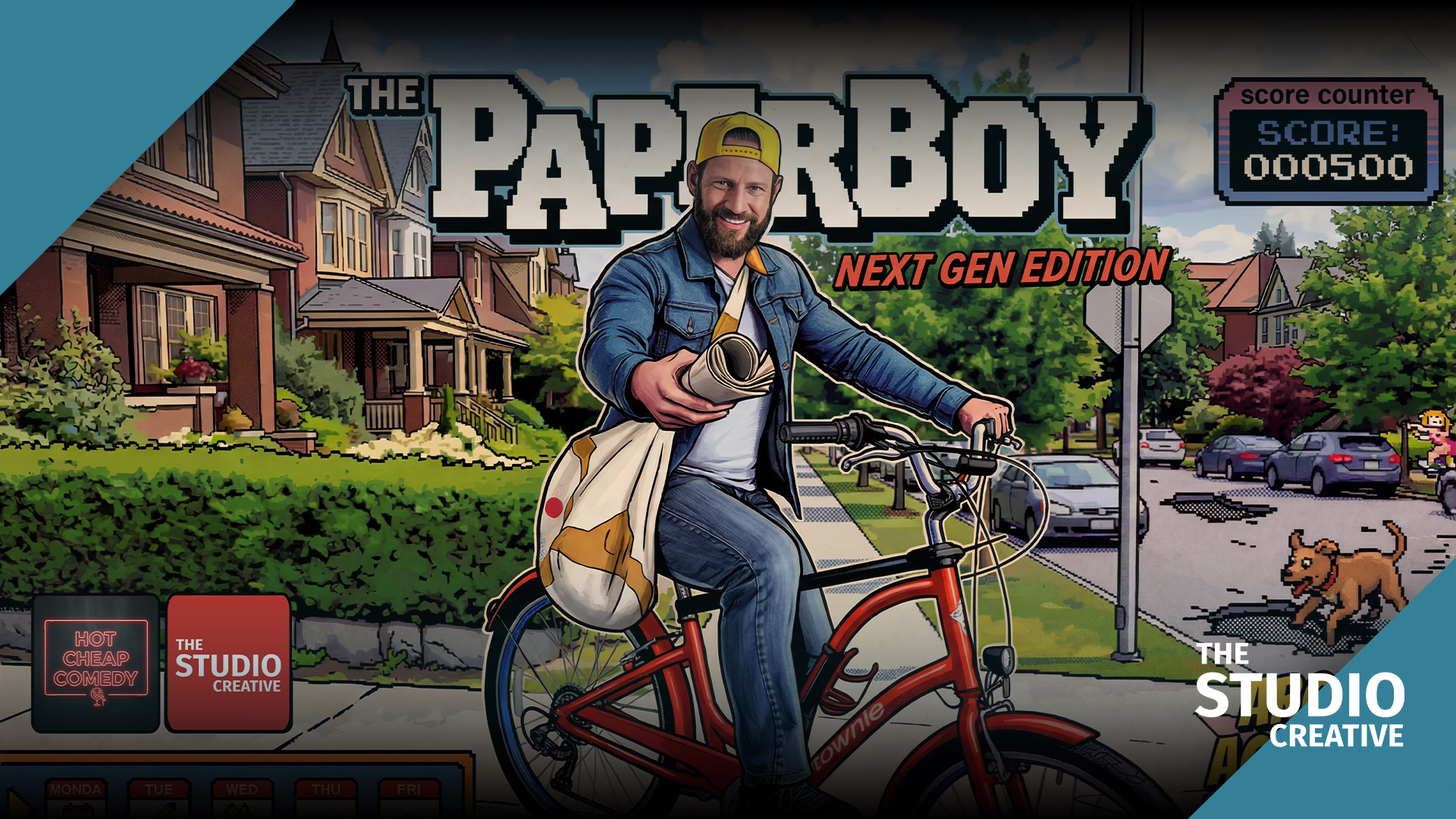
The Paperboy: Next Gen Edition is the most technically ambitious episode of Hot Cheap Comedy so far, and it was shot in a single afternoon on a green screen stage in Grand Blanc, Michigan. Every street, every hedge, every angry dog in the sketch was built after the performers went home. This is how we did it, what AI did and did not do, and the tool we built so the animation team was not guessing at what the actors were looking at.
At a glance
- One afternoon on green screen. Every street, hedge and angry dog in the sketch was built after the performers went home.
- An animatic for eyelines. The level played back on a monitor just off the lens axis so the cast could time their dodges.
- A real 8-bit look. Layered pixel art scaled with nearest-neighbor sampling, and chip-tune sound effects instead of recordings.
- AI in its lane. Concept frames, a rough key and a transcript assembly. People drew the sprites, animated the layers and timed the jokes.
The sketch
If you grew up on the arcade original, you know the premise: a kid on a bike, a suburban street, and a paper route that turns into an obstacle course. The Hot Cheap Comedy version asks what a "next gen" reboot would look like if the publisher had spent the whole budget on the trailer. The joke only works if the world looks like a real 8-bit game, which meant we could not fake it with a stock background.
Watch The Paperboy on its own page, then come back for the breakdown.
Filming: performing against a world that does not exist yet
The hard part of green screen comedy is not the key. It is the eyeline. A performer dodging a pixel-art mailbox has to look at the exact spot where the mailbox will be, three weeks before it exists. For this episode we pre-built the level as a rough side-scrolling animatic, then played it back on a monitor just off the lens axis so the cast could time their dodges to the actual obstacles.
- Lighting: a flat, even key on the screen at roughly two stops under the subject, with a hard rim from behind to separate the bike from the green. Retro games have no soft shadows, so we kept the talent lighting crisp and slightly toppy to match the look of the sprites.
- The bike: a real bike on a fixed stand. The wheels spin, the frame does not move. All apparent forward motion comes from the scrolling background, which is the same trick the original game used.
- Camera: locked off. Tracking a moving camera into a 2D scroller would have doubled the post time for no comedic gain.
Editing: the 8-bit pipeline
The world was built as layered pixel art, then animated as parallax layers so the background, the sidewalk, and the foreground scroll at different speeds. The performer plate sits between the middle and foreground layers, which is what sells the depth. Pixel art scaled up cleanly is the whole aesthetic, so every asset was drawn at native game resolution and scaled with nearest-neighbor sampling, never bilinear. Blurry pixels read as a mistake; sharp pixels read as a choice.
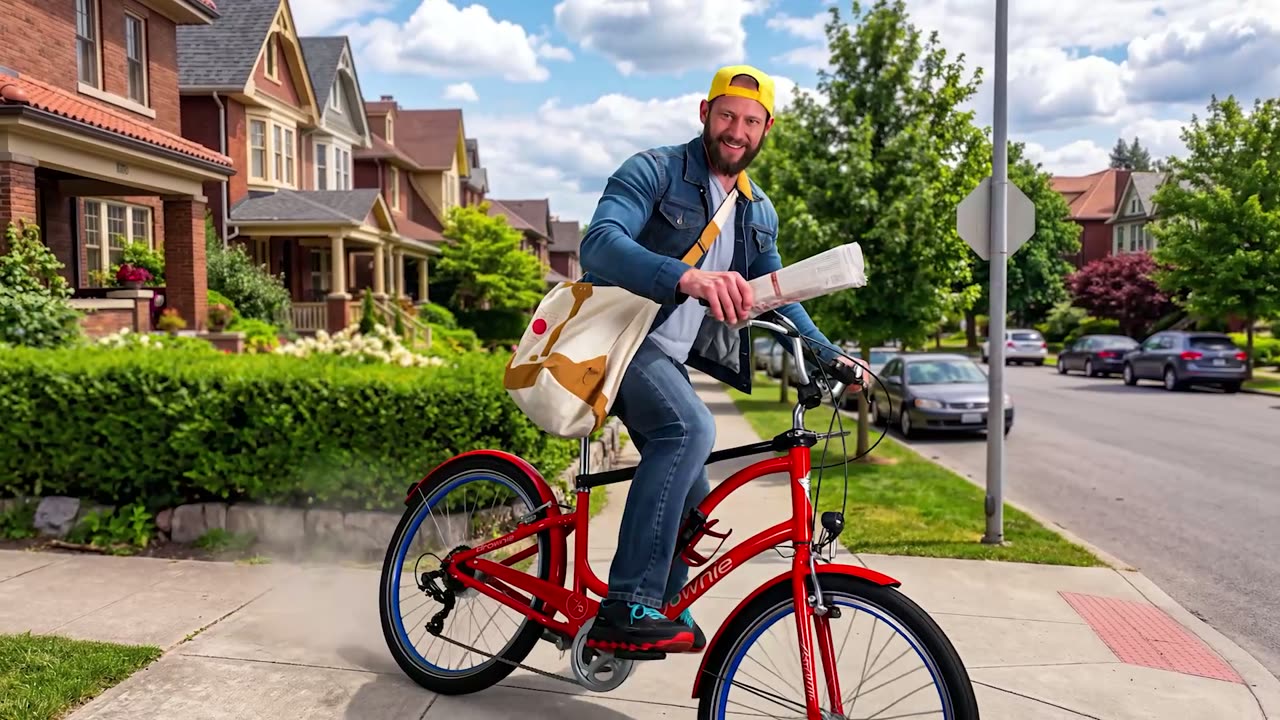
The paperboy on his route.
Sound design followed the same rule. Every effect is a synthesized chip-tune hit rather than a recorded sound. The hedge rustle is a noise burst, the dog is a three-note square wave, and the newspaper throw is a pitch sweep. It took an afternoon and it is one of the reasons the episode feels like a game rather than a sketch wearing a game costume.
Where AI helped, and where it did not
We are open about using AI in video production because we think the results speak for themselves, and because the honest answer is more useful than the mysterious one. On The Paperboy, AI did three jobs:
- Concept frames. Before anyone drew a pixel, we generated dozens of rough "what would this street look like" frames with an image model to agree on a palette and a level of detail. None of those frames ended up in the episode. They ended up in the brief.
- Keying assist. The rough key for the animatic playback was pulled with an AI matte tool so we could see the composite on set. The final key was still done by hand in the grade, with our spill-suppression preset chain handling green bounce on the bike frame.
- Transcript-based assembly. The first cut was assembled from an AI transcript of the takes, so the editor could pick the best read of every line by scanning text instead of scrubbing footage.
What AI did not do: draw the sprites, animate the layers, time the jokes, or write a line of the script. Generative video was not in the running for this one. The sketch depends on the performer and the world lining up to the frame, and that is still a human job.
Studio Projects: the world existed before the shoot
The reason the cast could dodge things that were not there yet is our own software, Studio Projects. You upload a basic script and it breaks the sketch down scene by scene with a visual example of each one, describes every character, builds a shot list per character so you can see at a glance how many scenes anyone is in, and generates background images that can stand in for the green screen. For The Paperboy, those generated streets were the first version of the level. We played them back on the set monitor for eyelines, handed them to the animation team as the brief, and only then drew the final pixel art on top. The animatic that saved the shoot started as a script upload.
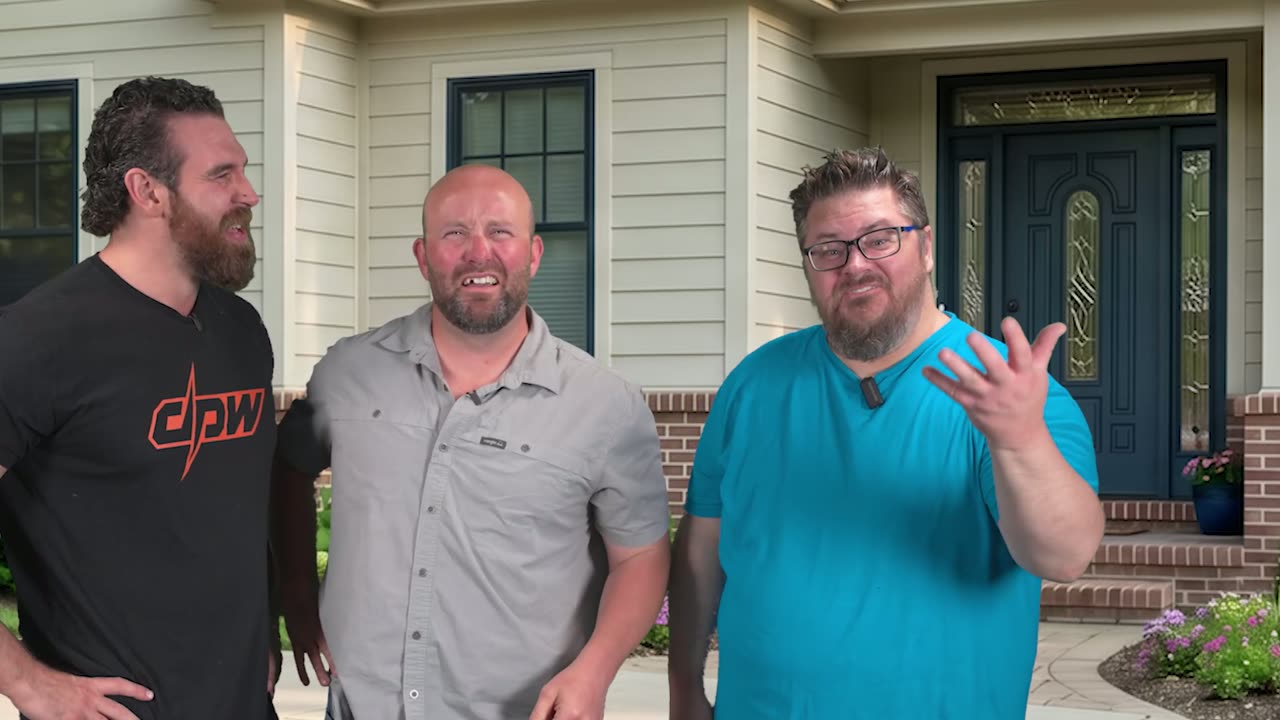
Three of the cast at a front door.
Why this matters beyond comedy
The same pipeline drops a product into a factory floor, a spokesperson into a trade show hall, or a founder into a cityscape that would cost a fortune to shoot for real. Green screen filming in Michigan does not have to mean a weather-map look. Done with matched lighting, a real eyeline, and a team that knows where the line between AI assistance and craft sits, it is the fastest way we know to make a small studio look like a large one.
Want this pipeline for your brand?
Everything in this post, from the green screen stage and the generated backgrounds to the AI-assisted edit and Studio Projects itself, is the same pipeline we use for brand films and commercials out of Grand Blanc, Michigan. If you want more video without a bigger budget, tell us what you're making and you'll get a real producer's reply, not a rate sheet. Browse the rest of the series on our work page.