
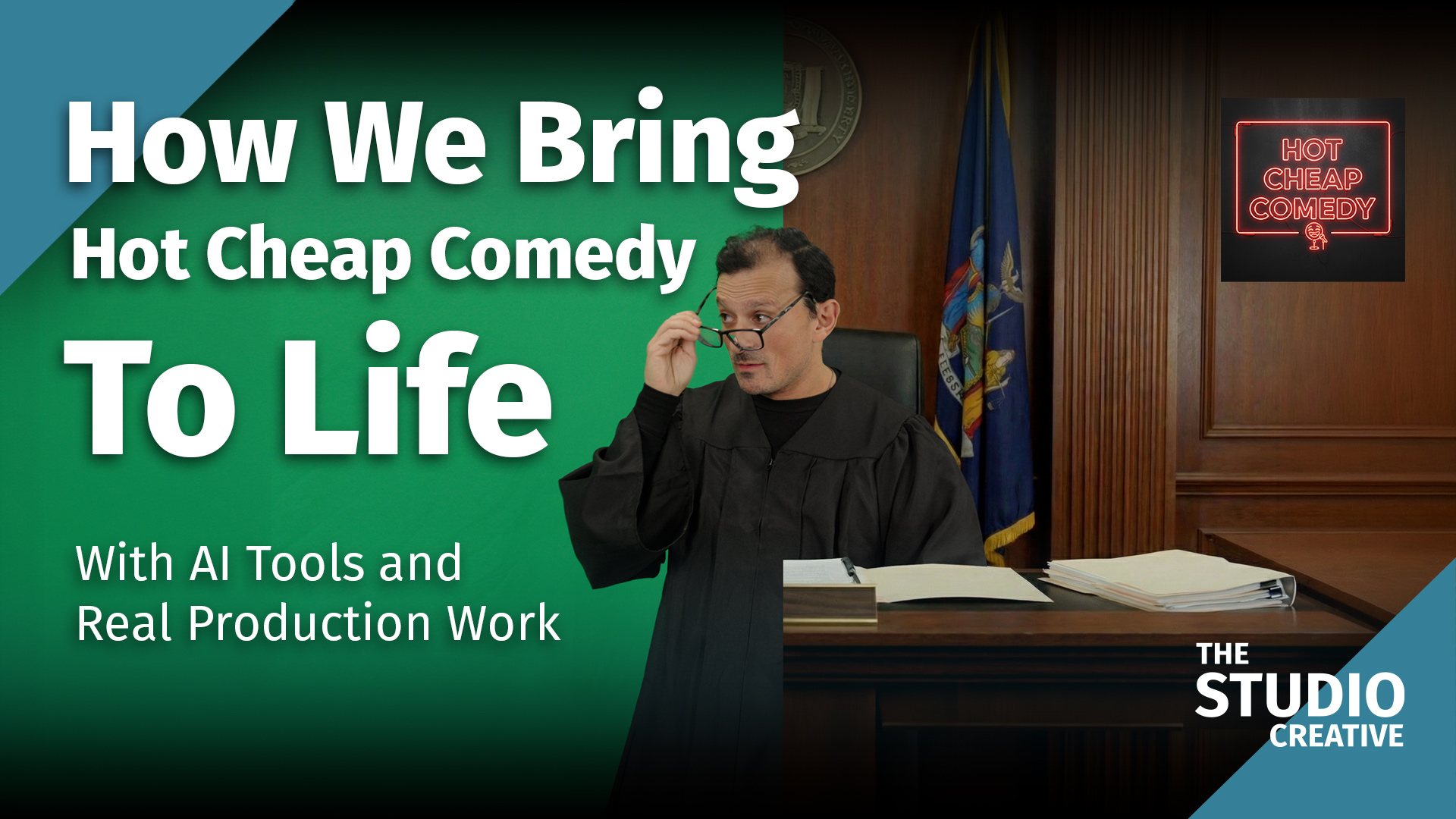
AI-Assisted Video Production Workflow Behind Hot Cheap Comedy
From Script to Studio
Everything starts with Josh’s writing.
Once a sketch is locked in, we start asking the real production questions. Where does this scene take place? How does the environment support the joke? What makes the moment visually interesting, not just verbally funny?
Filming happens in a controlled studio setup with professional lighting and green screen. That control matters. It lets us move a scene anywhere without being locked into one location. We can film multiple sketches across different days and still keep everything consistent.
We don’t treat it like someone just standing in front of a camera. We approach it like a short film. Even if it’s only a few minutes long.
Making the Background Match the Performance
Green screen has always had one big problem.
You shoot something, then spend hours hunting through stock photos trying to find a background that kind of works. The lighting is off. The angle feels wrong. The perspective doesn’t match. It slows everything down.
For a fast-moving sketch series, that process gets old fast.
So we changed the workflow.
After filming, we’ll often grab a still frame from the scene exactly as it was lit in the studio. That image becomes the reference point. Using tools like Nano Banana Pro, we generate environments built specifically to match the lighting direction, mood, and camera angle from that shot.
Instead of forcing the performance into a random stock background, we build the environment around the performance.
That small shift makes a big difference.
Where AI Fits In
AI is part of the workflow, but it’s not the star of the show.
Writing, directing, timing, performance, that’s all human. Comedy lives and dies on timing, and no software can replace that instinct.
We use tools like:
Nano Banana Pro
Veo 3
Kling 3.1
Artistly.io for creative assets
They help with environment creation, visual enhancements, animation, and faster experimentation in post-production.
What used to require bigger crews, bigger budgets, and bigger sets can now be done with a tight team and smart tools.
In the old-school setup, if you wanted a believable “new location,” you had a few choices - rent a space, build a set, dress a room, haul gear, schedule talent, fight weather, fight time, and pay for it all. Even a simple scene change could turn into a half-day of logistics. That’s the part people don’t see when a sketch looks “quick.”
With modern tools, we can keep the production tight and still give the joke a bigger world to play in. Green screen and AI-assisted environments let us move faster, iterate more, and try visual ideas that would normally get cut before they ever had a chance.
Now to be fair, a lot of videos look more realistic without AI.
We’re not married to the technology. We don’t force AI into a shot where real scenery is the better choice. If the scene will feel more grounded with natural light, real depth, and an authentic location, we’ll shoot it that way. That’s exactly why some moments in our second episode, The Gazette, were captured organically with no green screen at all. Sometimes the best production decision is the simplest one - put the camera in a real space and let the scene breathe.
That’s the real point. AI is a tool in the kit, not the kit itself.
We use it when it helps us:
build a world that matches the lighting and camera angle
create consistent environments across multiple shoot days
test different visual options quickly in post
pull off bigger visual ideas without a huge build or travel day
But the writing and the performance still lead. If the joke doesn’t land, no background on earth is going to save it - AI or otherwise.
The comedy still comes first. The tech just makes the sandbox bigger.
Editing Is Part of the Joke
Because Hot Cheap Comedy is built for video, editing isn’t just cleanup. It’s part of the punchline.
On stage, timing lives in pauses and delivery. On screen, timing lives in the cut.
We can tighten a beat by a fraction of a second and completely change how a joke lands. We can cut away at the exact wrong moment on purpose. We can hold on a reaction just long enough to make it uncomfortable, then snap to something absurd. That rhythm doesn’t happen by accident. It’s shaped in the edit.
Video gives us tools that a live performance simply doesn’t.
We can:
Jump cut to amplify awkwardness
Smash cut for surprise
Insert exaggerated reaction shots
Punch in digitally for emphasis
Cut mid-sentence for comedic interruption
Shift environments instantly to escalate a joke
A character can be in a courtroom one second and somewhere completely different the next. A background can change to underline irony. A subtle eye roll can become the focal point of the moment.
None of that replaces the writing. It enhances it.
Because the show is built screen-first, we don’t treat the camera like it’s documenting a performance. The camera is part of the performance. The edit is part of the writing.
What Happens Behind the Scenes
While Josh drives the creative vision, turning a script into a finished episode takes real production work:
Studio filming
Green screen compositing
Animation and visual effects
AI-assisted environment creation
Full post-production editing
It’s layered. It’s intentional. And it’s built around one goal.
Support the comedy without getting in its way.
Check out this behind the scenes video from one of our favorite episodes, Morning Groove. It shows the studio space, and some of the editing tools we utilize for each episode.
Where This Really Matters
Storytelling hasn’t changed. It’s still about strong ideas, sharp writing, and moments that connect.
What’s changed is access.
You no longer need a massive studio lot to execute a big visual idea. With the right tools and a solid production foundation, small teams can move faster and think bigger without losing quality. At The Studio Creative, we don’t start with technology. We start with the story. Then we use whatever tools help bring it to life cleanly and convincingly.
The goal is simple: Support the comedy without getting in its way.
Frequently Asked Questions
Is Hot Cheap Comedy filmed in front of a live audience?
No. The series is produced entirely in a studio environment. Each sketch is filmed on green screen and built in post-production, allowing complete creative control over locations, timing, and visual effects.
How does AI help in the production process?
AI is used to assist with environment creation, animation support, and visual experimentation during post-production. It helps speed up workflows and expand creative possibilities, but writing, directing, and performance remain fully human-driven.
Are the backgrounds real locations?
The environments are digitally created to match the lighting and camera angles from the studio shoot. Instead of using generic stock images, custom backgrounds are developed to support each specific scene.
What tools are used during production?
The workflow includes professional studio lighting, green screen compositing, animation tools, and AI platforms such as Nano Banana Pro, Veo 3, Kling 3.1, and creative asset libraries like Artistly.io.
Does AI replace traditional filmmaking?
No. Traditional filmmaking fundamentals still drive the process. Lighting, framing, performance, timing, and editing are handled with the same care as any professional production. AI simply removes technical barriers that used to require larger crews or bigger budgets.
Can this production approach be used for brands or businesses?
Yes. The same workflow used for Hot Cheap Comedy can support branded storytelling, educational content, conference media, and marketing campaigns. It allows ambitious visual ideas to be produced efficiently without sacrificing quality.
Why not just use stock backgrounds?
Stock assets often do not match lighting, perspective, or camera placement. Creating environments tailored to each scene results in more believable visuals and stronger storytelling.